
Mahound’s Founding Crisis and Return
The Satanic VersesThis flow follows Mahound’s emergence as a prophet, the compromise that produces the Satanic Verses episode, and his return to Jahilia to confront his former enemies.
increasing Bearing strength in each event
 decreasing
Bearing strength in each eventdecreasingThe Businessman on Mount Cone
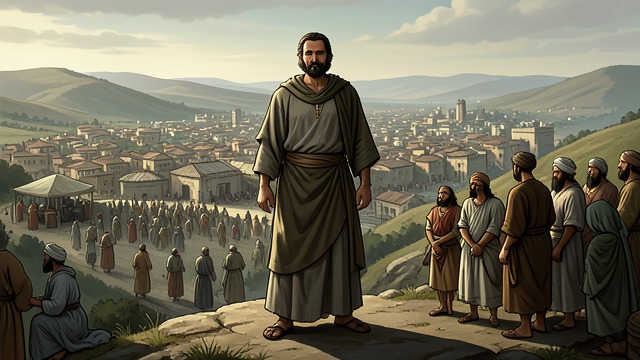
The Businessman on Mount Cone
From merchant to messenger
Mahound is a successful businessman and an outsider to Jahilia’s ruling circle. He climbs Mount Cone to seek solitude, while below him the city depends on trade, pilgrimage, and its many shrines. His message of one God challenges both the city’s religious customs and the commercial order built around them.
A small following and a large opposition
Khalid, Salman the Persian, Bilal, and Hamza gather around Mahound, but his audiences remain small. Abu Simbel sees the new faith as a threat to the temples and their revenues; he also recognizes that a single uncompromising idea may prove more dangerous than the city’s competing interests.
Mahound’s authority therefore begins in uncertainty. His followers may believe in his mission, but the city does not yet accept it, and he himself must confront whether his message can survive without compromise.
The Offer of Three Goddesses

The Offer of Three Goddesses
Abu Simbel’s political bargain
Abu Simbel proposes that Mahound recognize Lat, Uzza, and Manat as worthy of intercession. In return, the new faith would gain official tolerance and Mahound a place in Jahilia’s council. The offer appeals to Mahound because it promises converts and political standing, but it risks undermining the central claim that God is one.
Doubt inside the movement
Mahound’s followers debate the proposal. Salman warns that the bargain is a trap and could make the movement appear opportunistic; Bilal rejects the goddesses outright, while Hamza urges Mahound to seek an answer on the mountain. Mahound admits that making belief easier is beginning to matter to him.
The disagreement exposes the tension between survival and principle at the heart of the new faith. Mahound’s uncertainty is not simply a private weakness: his choice will determine what kind of community Submission becomes and whether its truth can be negotiated with power.
The Satanic Verses Episode

The Satanic Verses Episode
A public compromise
At a gathering of poets, Mahound recites a revelation that appears to grant the three goddesses a place in the sacred order. Abu Simbel and Hind respond with public submission, and the crowd follows. For a moment, the compromise seems to have won Jahilia for the new faith.
Repudiation and its cost
Mahound later concludes that the verses were satanic and publicly repudiates them. He replaces them with a declaration that the goddesses are only names and possess no divine authority. The reversal restores the message of one God, but it also exposes the political vulnerability of a revelation whose words have changed.
The consequences are personal as well as public. Mahound’s wife dies after the repudiation, persecution of his followers intensifies, and the once-brief triumph of compromise gives way to grief, doubt, and the need to leave Jahilia.
Exile and the Faithful’s Departure

Exile and the Faithful’s Departure
Persecution strengthens the movement
Abu Simbel imposes restrictions on the followers of Submission, including segregation, curfews, and bans on employment. Assaults and arson make life increasingly dangerous. Instead of dissolving the movement, the pressure brings more people into its ranks.
The first migration
Yathrib offers shelter to those willing to leave. Hamza argues that Mahound cannot complete his message in Jahilia, and the Prophet gives his consent. The believers depart with little, entering a new era through a journey that makes migration central to the community’s identity.
Mahound leaves later, alone, after the others have gone. His departure is not a triumphant escape from grief; it is a decision shaped by the limits of his power in Jahilia and by the need for the faith to survive elsewhere.
Conquest and the Test of Victory

Conquest and the Test of Victory
A changed city and a final surrender
Mahound returns to a diminished Jahilia after years of exile. Abu Simbel surrenders the city and urges its inhabitants to remain at home or seek shelter, while Hind calls for resistance. The people abandon her appeal as the reality of Jahilia’s decline overcomes the myths of its invulnerability.
Mercy and unfinished vengeance
Mahound enters the city, removes its idols, and accepts Hind when she submits. He also spares Salman after Bilal intercedes, though Salman had altered the recitation and fled. These decisions answer the question that had haunted Mahound’s followers: how will he behave when his enemies are at his mercy?
One unresolved name remains: Baal, whose poems once challenged Mahound and who has been hiding among the prostitutes of the Curtain. Mahound’s conquest establishes his authority, but the old conflict between prophetic power and satirical speech has not yet ended.
During Mahound’s early preaching in Jahilia
At the Festival of Ibrahim, before Mahound’s decisive recitation
At the poetry gathering in Jahilia, on the day Mahound recites The Star
After the repudiation, during the migration from Jahilia to Yathrib
About twenty-five years later, when Mahound returns to Jahilia
